What actually separates a consultant from a contractor?
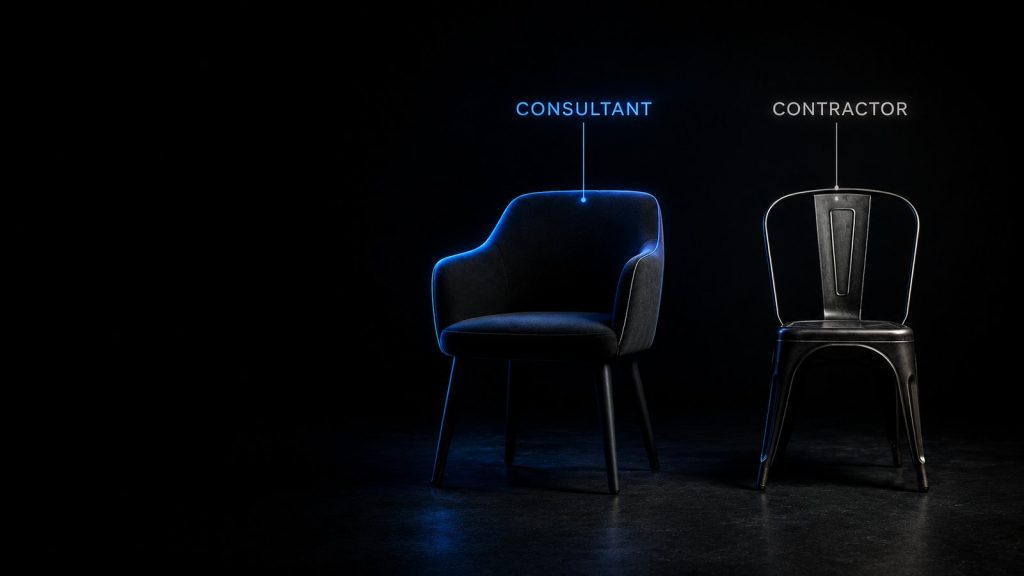
Two people can do identical work and one is worth three times the other. The difference is not skill. It is what they are accountable for.
The contractor sells hours; the consultant sells a decision#
A contractor is measured on delivery: did the thing get built, on time, to spec. A good one is invaluable and I hire them constantly.
A consultant is measured on whether the spec was right in the first place. That is a fundamentally different job, and it is worth more because it is upstream of everything the contractor will spend three months building.
If you take the brief as given, you are contracting. That is fine — but do not price it as consulting, and do not be surprised when the client treats you as interchangeable.
The tell is what happens when the brief is wrong#
Every engagement eventually reveals something the client did not know when they wrote the brief. What you do next defines which one you are.
A contractor builds what was asked and flags the issue. Nobody can fault them; it was in the scope.
A consultant stops, says the brief is aimed at the wrong problem, and makes the case for changing it — knowing that may shrink the project, delay the invoice, or end the engagement entirely.
The willingness to argue against your own revenue is the entire product. It is also why the relationship survives long enough to become a retainer.
The willingness to argue against your own revenue is the entire product.
Why “I’ll do whatever you need” is a positioning mistake#
It sounds accommodating. It reads as having no view. Someone with no view cannot be trusted with a decision, only with a task — so that is what you get offered, and tasks are priced by the hour against everyone else offering the same task.
Having a sharp opinion loses you some clients. It wins the ones who needed an opinion, and those are the engagements worth having.
The uncomfortable part of charging for judgement#
Judgement work is fast when it goes well. You can spend two hours in a session and change the direction of a year of spending. Billing for those two hours by the hour is absurd, and clients feel it too — nobody enjoys paying a large number for a short meeting.
Which is why the unit of sale has to be the outcome, not the time. A written diagnosis. A scoped recommendation. A decision someone can act on. Price the thing that has value, not the minutes it took.
What this means practically#
- Start with a diagnostic, not a proposal — you cannot scope what you have not diagnosed
- Put your view in writing early, including the part they will not like
- Say no to work you cannot improve on; referral costs you one project and buys years of trust
- Charge for the decision, deliver the artefact that proves it
That is the shape of every engagement I run, and why the first step is always a diagnostic rather than a pitch. When the work that follows needs more hands, The League is how it stays accountable to one owner.
Questions people ask
What separates a consultant from a contractor?
How do you tell which one you are being?
Why is "I'll do whatever you need" a positioning mistake?
How should judgement work be priced?
What does this mean practically?
Worth watching on this
Where to go next
When did you last argue against your own invoice?
Three questions, then I show you where I would start. No call needed to find out.